
Is reducing any market like reducing Rhino Horns or Cigarettes?
What does rational addiction tell us about the recent Aella controversy?

So content warning: I’m talking about child pornography in this post.
So recently folks like Nick Decker and Aella have floated the idea that “flooding the market” with AI child porn can reduce the production of child porn:

So I am of two minds on this, firstly that I think the idea is at best morally repugnant but possibly beneficial if it actually achieved its aims and eliminated the child pornography industry entirely. However, that is a big, big if.
Lyman stone has issued a response here tackling the If from an empirical perspective using the example of normal porn and rape, among others. I recommend it (even if I don’t always agree with Lyman).

Lyman’s response is quite good, and I recommend reading both articles. However, Lyman’s take only uses real-world data. I want to point out the theoretical inconsistencies with Aella’s argument.
Steel-manning the AI position
I think a good summary of Aella’s position is that she views the market for child pornography as similar to the market for Rhino horns or leopard furs. Basically that there is a normally market where supply and demand are not intertwined in confusing ways. Because the demand for rhino horns and leopard furs is derived from demand for traditional chinese medicines and modern fashions, therefore, solutions like flooding these markets high-quality mass-produced fakes could be a good solution. I think this case makes itself very clear, especially in Chen’s paper.
What does the addictive goods theory tell us?
So the rational addictive goods theory is more of a theory about habit forming goods. The initial framework comes from a 1988 paper by Gary Becker (the nobel laureate) and Kevin Murphy. It’s not a perfect model by any means but its a good starting point for getting a handle on how to think about this problem. Of course the actors involved in child pornography may not be perfectly rational, but I’m willing to make that simplification to make a broader point about how the economics of this may not be as simple as they are in the Rhino-Horn case.
The basics of the rational addiction model basically amount to; every time you consume an “addictive” good an imaginary “stock”, S, builds up per consumer, which decays at some rate δ. As this stock increases, the utility of consumption increases. This gives rise to two steady states, one unstable “lower” state and and one stable “higher” state where one is addicted. See the following state diagram (from the always great, Chicago Price Theory) to demonstrate this graphically.
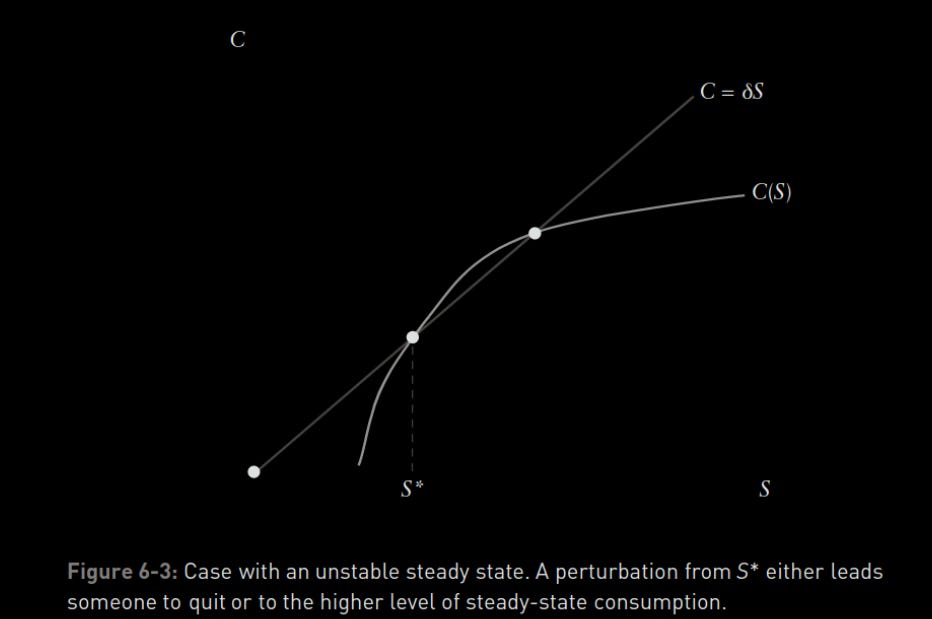
Now imagine that we have two populations of people (excluding normal, ethical people who will never touch the stuff), one “latent” group who will not consume in the lower state because the price of consumption is too high but will consume in the higher state, and one “explicit” group who will consume in both states. Also take for granted that “fake” pornography is not a perfect substitute for “real” pornography.
In the current state of the world (no free fake pornography), only the explicit group consumes the real stuff. If we enter into the world where fake pornography is now free, then the consumption of the real stuff depends on two things
1. The size of the latent group
2. The split between real/fake consumption in the explicit and latent groups.
So the amount of pornography consumed by the *explicit* group would certainly go down, but the problem is that the number of total consumers of pornography will go up and some of them will certainly consume some of the real stuff. This is what is called the intensive and extensive margin in academic economics. The “intensive” margin is how much of the “hard stuff” each person in the market consumes, and that will go down. The “extensive” margin is the number of people in the market, which will undoubtedly go up. The exact effect on the consumption of the real stuff will depend on the substitutability between the real stuff and the fake stuff, and the size of the “latent” population.
So overall it is *not* obvious to me that Aella’s argument holds up even in theory. And beyond that there are numerous issues with this idea in practice, because AI trained on child pornography will likely behave similarly to actual AI and mimic real-world people who in this case are the victims of child porn. AI has shown repeatedly that this ability to mimic real individuals and copyrighted is a feature, not a bug and cannot be eliminated from the LLM technology with prompt engineering workarounds.
I don’t really think this is a good way to reduce child pornography. It is ethically questionable at best and can harm real actual victims in the process, and may even *backfire.* Interesting thing to blog about, but not something anyone should do in practice.
Mathematical Coda:
For a full mathematical discussion see this video by Econ John:
And this video by Kevin Murphy himself:
Kevin Murphy Price Theory videos are addicting